Categories
Uncategorized

No One Cares, No One Saves: The Accountability Gap in HVAC Operation

Some years ago, there was an energy-saving modernization project on a building in the Czech Republic. Manual HVAC controls were replaced by a modern automation system. The result? Surprisingly, worse energy performance.


Why? The building’s longtime technician had known its quirks inside and out. Fine-tuning the system was part of his daily routine. Automation, while technically advanced, couldn’t match the outcome of this hands-on, nor replicate that level of care.


Here’s the catch: this story is the exception, not the rule.


In most buildings, manual control isn’t a secret weapon – it’s a liability. Automation can optimize settings, but it can’t force anyone to care. And that’s the real issue: no accountability.

🧍 The Human Side: Comfort Without Consequences

In most organizations, energy consumption is invisible – and therefore irrelevant –  to those who could influence it.  Local employees focus on their own comfort. Whether the AC is overcooling or running at night is simply not their concern. Their performance isn’t tied to energy efficiency, and no one asks them to think about it.


Even local or regional managers, who might seem like natural candidates to champion savings, often have different incentives. Their bonuses may depend on employee satisfaction, making any step that could slightly reduce comfort a potential risk. In this context, comfort always wins because no one is rewarded for thinking otherwise

🔧 The Technical Side: Responsibility Without Accountability

Lack of accountability doesn’t end with office staff or managers –  it’s deeply embedded in the technical and operational structure of many organizations. Even when people can influence energy performance, they often have no obligation or incentive to do so.


At Energy Twin, we’ve encountered this dynamic more than once. During an HVAC assessment of a large office building, the analysis revealed several opportunities for savings — some easy to implement. But when the findings were presented, the conversation stalled.


 “We don’t pay the energy bill, so we don’t care,” 


That’s what the building operator said. Only findings with potential impact on maintenance were taken seriously – even though several of the proposed energy-saving measures required minimal effort.


This isn’t an isolated incident. In many organizations, technical responsibilities are divided across roles, departments, and budgets. One team manages maintenance, another pays the energy bills, and a third oversees capital projects. No one is explicitly tasked or incentivized to focus on overall building performance. Efficiency becomes a shared interest, but nobody’s responsibility.


Some corporations are starting to recognize this gap. They’re building centralized energy teams, aligning KPIs across departments, or experimenting with internal cost accounting to make energy use more visible. But even in these cases, overcoming structural fragmentation is rarely easy. Without clear ownership and aligned incentives, energy optimization continues to fall between the cracks – known, measurable, but ignored.

Conclusion

The tools exist. The data is there. But without the motivation and mandate to act, insight becomes irrelevant. Real progress in building performance won’t come from more sensors. It will come from removing the human bottleneck: creating a culture where people can and want to optimize energy use.

HVAC systems may be technical, but the root of inefficiency is behavioral. If incentives reward comfort at all costs and ignore energy waste, that is exactly what buildings will continue to deliver.

Categories
Uncategorized

Smart EV Charging: Optimizing Demand in Shared Building Infrastructure

As electric vehicles (EVs) become more common, managing their charging demand presents new challenges – especially in buildings with limited grid connections. In this week’s newsletter we will explore how mathematical optimization can address these challenges, reducing costs and avoiding peak loads.

The Challenge: Shared Grid Connections

When multiple EVs share a grid connection with an office or residential building, uncoordinated charging can cause demand spikes, driving up energy costs and straining infrastructure. Traditional strategies – like immediate charging upon arrival – fail to consider electricity price fluctuations or building energy usage.

The Solution: Predictive, Demand-Aware Optimization

In the following scenarios, we demonstrate how combining machine learning with electricity price prediction and building load forecasting enables smarter EV charging strategies. The scenarios simulate a typical workday where eight EVs arrive at 8:00 AM with 30% battery charge and are required to depart by 4:00 PM with 90% charge.


Each of the following charts includes:

  • An upper bar chart showing the predicted energy consumption of the building and the charging load of EVs 1-8
  • A line chart representing the forecasted electricity price for the day

Scenario 1: Immediate Charging


In this scenario the charging starts immediately after plug-in.

This approach results in a peak demand of 854 kW and a total energy cost of €57. Because charging takes place during high-tariff periods, it leads to both elevated costs and significant power demand.


Scenario 2: Price-Based Optimization


Introducing optimization to minimise total charging cost.

Although the total electricity cost is reduced to €40, the peak demand rises to 960 kW as charging overlaps with the building’s HVAC cooling peak.


Scenario 3: Price &Power Optimization


In this final scenario, we introduce a constraint on maximum power demand, alongside the goal of minimizing total charging costs.

This approach results in a peak demand of 650 kW (the predefined limit), and a total electricity cost of €41.


When applied to a different day with varying electricity prices, the charging profile changes significantly – reflecting both price fluctuations and shifts in the building’s energy consumption.

These variations highlight a key insight: optimal charging strategies cannot be defined using static if-then rules. Instead, mathematical optimization is essential.


On some days, the most cost-effective strategy is to start charging immediately.

And if you time it well, you can even earn money.

While this is a simulation, it illustrates the complexity of real-world implementation. Achieving flexibility requires modular, multi-layered systems and open APIs, rather than rigid, single-vendor platforms. Ignoring energy flexibility can lead to increased costs, grid stress, and missed opportunities.


To move from simulation to real-world deployment, several challenges must be addressed:

  • EV chargers’ interface
  • Real-time access to building load data
  • Online retrieval of electricity prices
  • Data integrity and fail-safe mechanisms
  • Fulfillment of all cybersecurity requirements
  • Compliance with national grid codes and metering laws
  • Risk of damaging battery health with poor control logic
  • Responsibility for missed departures

As EV adoption grows, so does the need for intelligent charging strategies—especially in shared building infrastructures. Our simulations highlight that static rules aren’t enough; real-time optimizationbased on forecasts and constraints is essential.


While the path to real-world deployment involves technical and regulatory challenges, the benefits are clear: lower costs, reduced peak loads, and greater grid resilience. With the right tools and flexibility, EV charging can become a powerful part of smarter energy systems.

Categories
Uncategorized

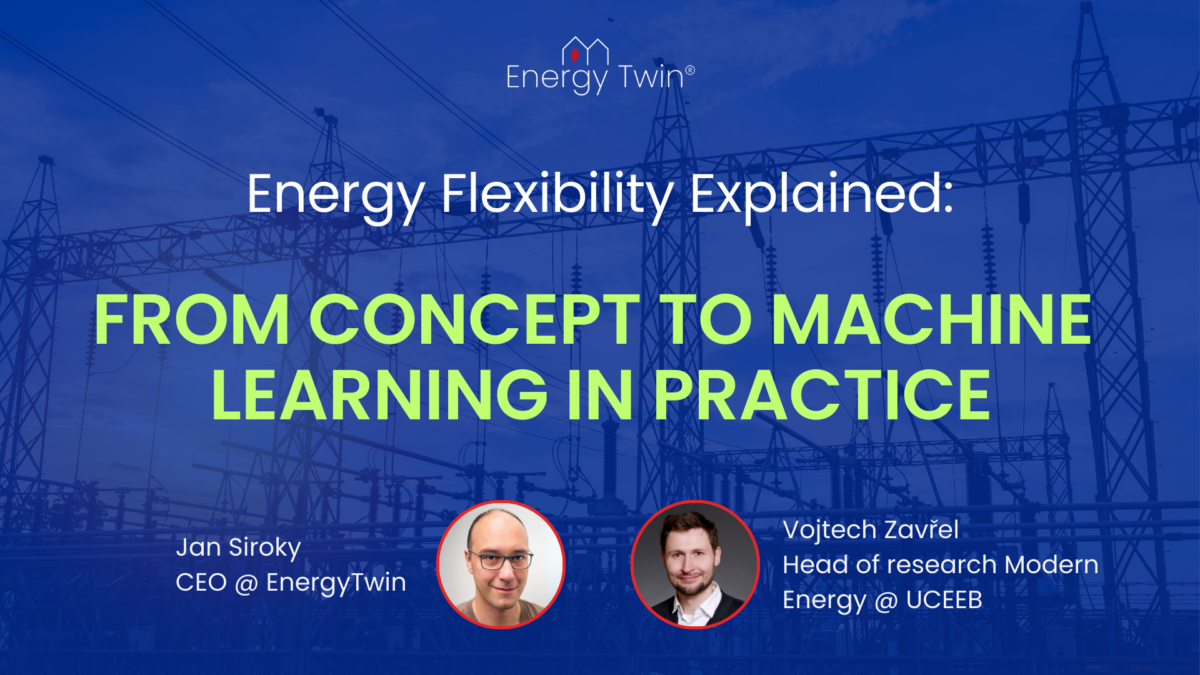
Webinar recording: Energy Flexibility Explained – From Concept to Machine Learning in Practice

Energy Twin and the University Centre for Energy Efficient Buildings (UCEEB) of Czech Technical University in Prague explored the rising importance of load-side flexibility in today’s dynamic energy systems. With variable renewables on the rise, from solar in California to wind in Denmark and hydro in Scandinavia, adapting demand to real-time grid conditions is becoming a major competitive advantage.


This webinar covers the flexibility concept and shows how machine-learning-based predictions of building energy use enable smarter demand response, battery scheduling, and energy cost minimization. Real-world examples demonstrate how predictive models help integrate buildings into decentralised and fast-evolving energy grids.


The topics covered include:
Energy Flexibility: Markets, Challenges, and Opportunities – V. Zavřel, UCEEB

  • Overview of flexibility in global energy systems and growing demand-side potential
  • Impact of renewables and decentralisation on grid dynamics
  • Role of buildings in providing grid flexibility without ready-made solutions
  • Challenges and opportunities for commercial building operators

Predicting Building Energy Use for Flexibility – J. Široký, Energy Twin

  • How AI-driven forecasts enable smarter demand response and cost reduction
  • Case study: ML model peak demand analysis
  • Research insight: Community-driven flexibility challenges