
Categories
Uncategorized

Large Language Models in Energy and Buildings – Recent Perspectives

Perspectives

Large language models (LLMs) have rapidly become one of the hottest topics across industries, and the building and energy domains are no exception. Over just the past few months, a surprisingly large number of research papers have appeared exploring how LLMs could support building operations, energy efficiency, and market integration. In this week’s newsletter, we don’t aim to provide an exhaustive review – instead, we highlight a few representative studies that illustrate the variety of directions in which the field is evolving.


A useful starting point is the overview by Liu et al. (2025), which maps out potential applications of LLMs in building-energy contexts. The authors identify several key directions: conversational interfaces for facility and energy managers; knowledge extraction from technical documentation and regulatory texts; integration with building management and energy information systems; natural language explanations of model outputs and diagnostics; support for predictive control and demand flexibility; and connections to digital twins. This framework creates a helpful lens for understanding more specialized work.


One line of work focuses on recommendation systems based on real and simulated building data. Papaioannou, Korkas and Kosmatopoulos (2025) demonstrate how fine-tuned LLMs can generate context-aware suggestions that balance comfort and energy use. They emphasize the importance of working directly with raw data streams and reducing them to the most relevant information for decision-making – an approach that resulted in measurable energy savings in a residential case study.


Another direction explores the question–answer frameworks for HVAC systems. Lee et al. (2025) introduce the JARVIS system, where an expert LLM translates user queries into structured SQL instructions, retrieves sensor data, and provides interpretable answers. This work shows how LLMs can bridge the gap between non-expert users and complex operational databases.


Beyond building operations, LLMs are also entering the energy markets. Lu et al. (2025) propose market agents that use LLMs to model bidding behavior and analyze sentiment in electricity markets, while Zhang et al. (2024) apply LLMs to parameter prediction in integrated energy systems, where traditional methods often struggle. Antonesi et al. (2025) take a broader view, reviewing AI developments in the energy sector and highlighting the emerging role of LLM-enabled agentic digital twins.


In the modeling domain, Jiang et al. (2024) present EPlus-LLM, a platform where LLMs automate tasks in EnergyPlus building simulations. Khanuja and Webb (2024) examine whether LLMs can interpret databases of energy efficiency measures and classify them into meaningful categories. At a macro scale, Taheri Hosseinkhani (2025) discusses how LLMs could contribute to economic modeling and decarbonization strategies.


Finally, several studies explore links between LLMs and digital twins. Yang, Siew and Joe-Wong (2024) describe an LLM-driven twin that supports “human-in-the-loop” optimization, while complementary reviews such as Khanuja and Webb (2024) highlight how LLMs are emerging as a natural extension of AI tools for intuitive, user-centered interfaces in smart buildings.


Taken together, these works underscore the accelerating momentum of LLMs in the building and energy sectors. Rather than focusing on a single use case, researchers are testing a wide range of ideas – from facility-facing chatbots to market agents, from simulation support to digital twins. It’s an exploratory phase, but one with clear potential to reshape how data, systems, and people interact in the built environment.


Do you have any thoughts on the role of LLMs in the built environment?


Feel free to share your perspective in the discussion.


For those who want to dig deep, here’s a list for some further reading!


Liu, M., Zhang, L., Chen, J., et al. (2025). Large language models for building energy applications: Opportunities and challenges. Building Simulation.


Papaioannou, I., Korkas, C., Kosmatopoulos, E. (2025). Smart Building Recommendations with LLMs. Buildings. 


Lee, S., Kang, M., Lee, J., et al. (2025). LLM-based Question-Answer Framework for Sensor-driven HVAC Systems. 


Lu, X., Qiu, J., Yang, Y., et al. (2025). LLM-Based Bidding Behavior and Market Sentiment Agent for Electricity Prices. IEEE TEMPR. 


Zhang, H., Zhang, L., Yu, L., Zhu, R. (2024). LLM-Assisted Parameter Prediction in Integrated Energy Systems. China Automation Congress. 


Antonesi, G., Cioara, T., Anghel, I., et al. (2025). From Transformers to LLMs: A Review of AI in the Energy Sector. 


Jiang, G., Ma, Z., Zhang, L., Chen, J. (2024). EPlus-LLM: Automating EnergyPlus Modeling with LLMs. Applied Energy. 


Khanuja, A., Webb, A. L. (2024). Can LLMs Understand Energy Efficiency Measures (EEMs)? SimBuild Conf. 


Taheri Hosseinkhani, N. (2025). AI and LLMs in Energy Systems and Climate Strategies. Preprint. 


Yang, H., Siew, M., Joe-Wong, C. (2024). An LLM-Based Digital Twin for Human-in-the-Loop Optimization. 

Categories
Uncategorized

Making Every Day Count: Why Occupancy Patterns Matter in ML Models for Energy Optimization

In the realm of energy data evaluation, machine learning models have unlocked significant potential. These tools support everything from energy conservation analysis to anomaly detection and optimization. But at the heart of any successful application lies one essential ingredient: a model that accurately reflects how buildings operate in the real world.


One often-overlooked challenge in achieving this reliability lies in managing the different operating regimes of a building. While weekly or monthly data evaluations may overlook these nuances, interval data analysis (e.g., hourly or 15-minute intervals) demands a deeper understanding of how building operation changes over time. In this newsletter, we explore how to address this challenge by distinguishing between occupied and unoccupied days and properly accounting for holidays.

Start with the Basics:  Occupied vs. Unoccupied Days

Commercial buildings frequently exhibit markedly different energy consumption patterns during workdays versus weekends. For simplicity, let’s assume the building is unoccupied during weekends, with a typical energy setback in place. This means reduced base consumption and adjusted weather-related loads reflecting heating or cooling setbacks.

Level Up Your Model: Don’t Ignore Holidays

Holidays pose unique challenges. They may seem insignificant due to their low frequency, but failing to address them can undermine model accuracy. For instance, if a model assumes a holiday is a regular weekday, the unusually low consumption may be misclassified—skewing predictions or masking anomalies.


That’s why we treat holidays as their own category, distinct from both weekdays and weekends. By recognizing their unique behavior, we turn potential outliers into expected patterns – improving model stability and predictive power.

A Real-World Example

Imagine we’re identifying a model using only three months of data – specifically Q2 2023. In the Czech Republic, this period includes four public holidays, three of which fall on a Monday. How does that influence the outcome?


In the chart below, you can see a comparison of two models on a regular week in February, when no public holidays occurred:

  • The blue line represents a model identified on Q2 2023 data with public holidays correctly taken into account.
  • The green line shows a model identified on the same data without accounting for holidays.
  • The red line shows actual measured consumption.
A Real-World Example

Imagine we’re identifying a model using only three months of data – specifically Q2 2023. In the Czech Republic, this period includes four public holidays, three of which fall on a Monday. How does that influence the outcome?


In the chart below, you can see a comparison of two models on a regular week in February, when no public holidays occurred:

  • The blue line represents a model identified on Q2 2023 data with public holidays correctly taken into account.
  • The green line shows a model identified on the same data without accounting for holidays.
  • The red line shows actual measured consumption.

Notice how the green line significantly underestimates Monday consumption. By treating holidays as regular weekdays, the model learned an unrealistically low baseline – introducing a bias of more than 25 kW from just a few misclassified days. Why does this happen? In this case, 3 out of the 13 Mondays in the training data were public holidays. Without that context, the model tried to minimize error across all Mondays, combining regular and atypical days into a single profile. This pulled the expected load for Mondays lower, resulting in a distorted time-dependent pattern that doesn’t reflect actual operations. 


How do we handle holidays correctly to avoid this kind of mistake? It comes down to two things: identifying them accurately and modeling them appropriately.

Step One: Defining Holidays Automatically

Manually managing holiday calendars can be tedious and error-prone; especially when working with buildings across multiple countries or regions. At Energy Twin, we avoid this complexity by using a location-aware API (namely this great service https://date.nager.at/ ) that automatically downloads public holidays based on each building’s location. 

Step Two: Modeling Holidays Properly

Once holidays are identified, how should they be treated in the model? Should they behave like Sundays? Or should each holiday have its own profile? Modeling every holiday separately and ensuring that statistical properties of training data are met is not realistic (you do not have enough data to model each holiday separately). At the same time, lumping them in with weekends oversimplifies their unique patterns.

One method to find the right balance, used in our approach as well, is to define an “eighth weekday” for TOWT modeling. This captures the distinct behavior of holidays without overfitting, helping your model remain both generalizable and precise.

Conclusion

When weekend or holiday behavior is oversimplified, it can distort the entire model, leading to misleading savings estimates or missed anomalies. By clearly separating weekdays, weekends, and holidays, and capturing their temperature-driven dynamics, models better reflect real-world building operations.


This is especially important when following M&V (Measurement & Verification) guidelines, which typically require an R² above 0.75 and a CV(RMSE) below 25%. A model that previously failed to meet these criteria can suddenly fall into compliance by explicitly handling these exceptions. This reduces error, improves accuracy, and builds trust in your analytics.


When every day matters, holidays included, it’s worth taking the extra step to model building behavior as it truly occurs. That’s the kind of detail that helps turn data into decisions – and it’s a key part of the approach we take at Energy Twin.

Categories
Uncategorized

No One Cares, No One Saves: The Accountability Gap in HVAC Operation

Some years ago, there was an energy-saving modernization project on a building in the Czech Republic. Manual HVAC controls were replaced by a modern automation system. The result? Surprisingly, worse energy performance.


Why? The building’s longtime technician had known its quirks inside and out. Fine-tuning the system was part of his daily routine. Automation, while technically advanced, couldn’t match the outcome of this hands-on, nor replicate that level of care.


Here’s the catch: this story is the exception, not the rule.


In most buildings, manual control isn’t a secret weapon – it’s a liability. Automation can optimize settings, but it can’t force anyone to care. And that’s the real issue: no accountability.

🧍 The Human Side: Comfort Without Consequences

In most organizations, energy consumption is invisible – and therefore irrelevant –  to those who could influence it.  Local employees focus on their own comfort. Whether the AC is overcooling or running at night is simply not their concern. Their performance isn’t tied to energy efficiency, and no one asks them to think about it.


Even local or regional managers, who might seem like natural candidates to champion savings, often have different incentives. Their bonuses may depend on employee satisfaction, making any step that could slightly reduce comfort a potential risk. In this context, comfort always wins because no one is rewarded for thinking otherwise

🔧 The Technical Side: Responsibility Without Accountability

Lack of accountability doesn’t end with office staff or managers –  it’s deeply embedded in the technical and operational structure of many organizations. Even when people can influence energy performance, they often have no obligation or incentive to do so.


At Energy Twin, we’ve encountered this dynamic more than once. During an HVAC assessment of a large office building, the analysis revealed several opportunities for savings — some easy to implement. But when the findings were presented, the conversation stalled.


 “We don’t pay the energy bill, so we don’t care,” 


That’s what the building operator said. Only findings with potential impact on maintenance were taken seriously – even though several of the proposed energy-saving measures required minimal effort.


This isn’t an isolated incident. In many organizations, technical responsibilities are divided across roles, departments, and budgets. One team manages maintenance, another pays the energy bills, and a third oversees capital projects. No one is explicitly tasked or incentivized to focus on overall building performance. Efficiency becomes a shared interest, but nobody’s responsibility.


Some corporations are starting to recognize this gap. They’re building centralized energy teams, aligning KPIs across departments, or experimenting with internal cost accounting to make energy use more visible. But even in these cases, overcoming structural fragmentation is rarely easy. Without clear ownership and aligned incentives, energy optimization continues to fall between the cracks – known, measurable, but ignored.

Conclusion

The tools exist. The data is there. But without the motivation and mandate to act, insight becomes irrelevant. Real progress in building performance won’t come from more sensors. It will come from removing the human bottleneck: creating a culture where people can and want to optimize energy use.

HVAC systems may be technical, but the root of inefficiency is behavioral. If incentives reward comfort at all costs and ignore energy waste, that is exactly what buildings will continue to deliver.

Categories
Uncategorized

Smart EV Charging: Optimizing Demand in Shared Building Infrastructure

As electric vehicles (EVs) become more common, managing their charging demand presents new challenges – especially in buildings with limited grid connections. In this week’s newsletter we will explore how mathematical optimization can address these challenges, reducing costs and avoiding peak loads.

The Challenge: Shared Grid Connections

When multiple EVs share a grid connection with an office or residential building, uncoordinated charging can cause demand spikes, driving up energy costs and straining infrastructure. Traditional strategies – like immediate charging upon arrival – fail to consider electricity price fluctuations or building energy usage.

The Solution: Predictive, Demand-Aware Optimization

In the following scenarios, we demonstrate how combining machine learning with electricity price prediction and building load forecasting enables smarter EV charging strategies. The scenarios simulate a typical workday where eight EVs arrive at 8:00 AM with 30% battery charge and are required to depart by 4:00 PM with 90% charge.


Each of the following charts includes:

  • An upper bar chart showing the predicted energy consumption of the building and the charging load of EVs 1-8
  • A line chart representing the forecasted electricity price for the day

Scenario 1: Immediate Charging


In this scenario the charging starts immediately after plug-in.

This approach results in a peak demand of 854 kW and a total energy cost of €57. Because charging takes place during high-tariff periods, it leads to both elevated costs and significant power demand.


Scenario 2: Price-Based Optimization


Introducing optimization to minimise total charging cost.

Although the total electricity cost is reduced to €40, the peak demand rises to 960 kW as charging overlaps with the building’s HVAC cooling peak.


Scenario 3: Price &Power Optimization


In this final scenario, we introduce a constraint on maximum power demand, alongside the goal of minimizing total charging costs.

This approach results in a peak demand of 650 kW (the predefined limit), and a total electricity cost of €41.


When applied to a different day with varying electricity prices, the charging profile changes significantly – reflecting both price fluctuations and shifts in the building’s energy consumption.

These variations highlight a key insight: optimal charging strategies cannot be defined using static if-then rules. Instead, mathematical optimization is essential.


On some days, the most cost-effective strategy is to start charging immediately.

And if you time it well, you can even earn money.

While this is a simulation, it illustrates the complexity of real-world implementation. Achieving flexibility requires modular, multi-layered systems and open APIs, rather than rigid, single-vendor platforms. Ignoring energy flexibility can lead to increased costs, grid stress, and missed opportunities.


To move from simulation to real-world deployment, several challenges must be addressed:

  • EV chargers’ interface
  • Real-time access to building load data
  • Online retrieval of electricity prices
  • Data integrity and fail-safe mechanisms
  • Fulfillment of all cybersecurity requirements
  • Compliance with national grid codes and metering laws
  • Risk of damaging battery health with poor control logic
  • Responsibility for missed departures

As EV adoption grows, so does the need for intelligent charging strategies—especially in shared building infrastructures. Our simulations highlight that static rules aren’t enough; real-time optimizationbased on forecasts and constraints is essential.


While the path to real-world deployment involves technical and regulatory challenges, the benefits are clear: lower costs, reduced peak loads, and greater grid resilience. With the right tools and flexibility, EV charging can become a powerful part of smarter energy systems.

Categories
Uncategorized

Webinar recording: Energy Flexibility Explained – From Concept to Machine Learning in Practice

Energy Twin and the University Centre for Energy Efficient Buildings (UCEEB) of Czech Technical University in Prague explored the rising importance of load-side flexibility in today’s dynamic energy systems. With variable renewables on the rise, from solar in California to wind in Denmark and hydro in Scandinavia, adapting demand to real-time grid conditions is becoming a major competitive advantage.


This webinar covers the flexibility concept and shows how machine-learning-based predictions of building energy use enable smarter demand response, battery scheduling, and energy cost minimization. Real-world examples demonstrate how predictive models help integrate buildings into decentralised and fast-evolving energy grids.


The topics covered include:
Energy Flexibility: Markets, Challenges, and Opportunities – V. Zavřel, UCEEB

  • Overview of flexibility in global energy systems and growing demand-side potential
  • Impact of renewables and decentralisation on grid dynamics
  • Role of buildings in providing grid flexibility without ready-made solutions
  • Challenges and opportunities for commercial building operators

Predicting Building Energy Use for Flexibility – J. Široký, Energy Twin

  • How AI-driven forecasts enable smarter demand response and cost reduction
  • Case study: ML model peak demand analysis
  • Research insight: Community-driven flexibility challenges
Categories
Uncategorized

How to Save 1 Million EUR on Electricity in Commercial Buildings – Without the Hassle

Energy savings are a cornerstone of any robust ESG strategy, driving both environmental responsibility and financial performance. At Energy Twin, we leverage advanced AI to seamlessly integrate energy optimization into your building’s operations—delivering substantial cost reductions with minimalized extra workload to your team.


Consider a banking institution with an annual consumption of 50 GWh, where our AI analysis uncovered up to 1 million EUR in potential savings. While each building is unique—some with valid reasons for higher consumption—most branches hide inefficiencies that can be addressed. An AI-driven approach not only reveals these opportunities but also directs your teamon where to focus their efforts. Ultimately, it’s up to you how much of these savings you will be able to implement.


Let’s break down the process into three essential steps:

1. Being Data-Driven

Data is at the heart of effective energy management. Ideally, you’ll have easy, automated access to consumption data—often through APIs and smart meters. Even just the main meter data can reveal surprising inefficiencies thanks to advanced AI algorithms. Of course, the more data you have, the deeper the analysis can go. Additional data points (e.g., sub-meters, HVAC controls, lighting systems) allow for more granular insights and targeted solutions.

2. Continuously Identifying Inefficiencies with AI

Traditional energy optimization often relies on one-time audits or manual adjustments that quickly become outdated. A modern approach uses continuous data monitoring and advanced AI to:

  • Uncover Hidden Anomalies: Detect unusual consumption patterns that might be overlooked in manual checks.
  • Drive Ongoing Optimization: Provide continual recommendations rather than one-off improvements.
  • Offer Transparent Insights: Deliver unbiased data to help you make clear, objective decisions.

At Energy Twin, we handle the data analysis and AI processes on your behalf. This means minimal additional effort for your team.

3. Incorporating AI Insights into Routine Maintenance

While AI can identify and quantify inefficiencies, the actual savings happen when your technicians or facility managers act on those insights. We recommend:

  • Regular Meetings: Hold monthly (or bi-weekly) sessions to review AI findings and track progress.
  • Clear Objectives: Set tangible goals for energy savings and establish timelines for corrective actions.
  • Team Engagement: Ensure technicians understand both the data and the potential impact of their interventions.

Energy Twin supports you every step of the way with feedback and guidance, but your team is key to turning insights into measurable results.

Ready to Unlock Significant Savings?

By combining AI-driven analysis with proactive facility management, commercial buildings can unlock substantial savings. With Energy Twin’s solution, you gain the insights you need without overburdening your staff or disrupting daily operations.

Interested in learning more about how our platform can help you save on electricity costs? Get in touch with us today for a personalized consultation and find out how easy it can be to start optimizing your building’s energy consumption.

Categories
Uncategorized

Decoding Weather-Dependent Loads: Key Patterns and Practical Insights

In one of our previous posts, we have covered what weather-dependent load is and how it can provide valuable insights into building energy consumption. This week, we’re focusing on specific examples that showcase common weather dependent energy patterns we observe when analyzing buildings.


For all the examples, the x-axis represents outdoor air temperature in °C, and the y-axis shows the additional weather-related energy consumption in kW. The blue line indicates unoccupied regime consumption, while the red line represents occupied regime consumption.

Cooling dominated building
Figure 1 - An example of a cooling dominated building with implemented cooling setback.

In Figure 1, we see a typical cooling-dominated building with well-managed operations. Notice how energy consumption rises with increasing temperatures only during the occupied regime. During unoccupied periods, the energy consumption remains flat, indicating that the cooling setback is functioning effectively. This is the desired behavior.

Figure 2 - An example of a cooling dominated building with not sufficient cooling setback.

However, in Figure 2, we see a different scenario. While there is some distinction between the occupied and unoccupied regimes, the gap is not sufficient to indicate effective cooling setback. This suggests that cooling continues even when the building is unoccupied, revealing energy savings potential.

Heating dominated buildings

The same logic applies to heating-dominated buildings. Heating setbacks during unoccupied periods should be optimized to balance energy savings with thermal inertia. Overly aggressive reductions—such as complete weekend shutdowns—can delay Monday warm-up and strain HVAC systems during recovery. A practical target is an 80% heating setback. For example, if the heating-related load is 10kW, the unoccupied load should ideally be 8kW. Reducing the indoor temperature by just 1°C can lower the heating load by approximately 6%.

Figure 3 - An example of a heating dominated building with implemented heating setback.

Figure 3 demonstrates a heating-dominated building with a well-implemented setback. In contrast, Figure 4 shows a building where heating setback is either nonexistent or poorly implemented, as indicated by the overlapping consumption patterns.

Figure 4 - An example of a heating dominated building with no implemented heating setback.
Buildings with Both Heating and Cooling Loads

Of course, a building doesn’t have to be just cooling or heating dominated. Many energy patterns resemble a “U” shape, where we have some heating-related energy consumption in colder months, minimal load during shoulder periods, and cooling-related consumption in warmer months. How should we interpret such patterns, and what should we focus on? Let’s look at a few examples.

Figure 5 - An example of a weather dependent load of a building with both heating and cooling loads with no implemented setback.

In Figure 5, we see a building with both heating and cooling loads, but with almost no distinction between the occupied and unoccupied regimes. The slight reduction in cooling load during unoccupied hours is not sufficient to indicate effective setback implementation. Uncovering immediate savings opportunities can be as easy as reviewing existing equipment schedules and setpoints with no need for costly investment.

Figure 6 - An example of a weather dependent load of a building with both heating and cooling loads with implemented cooling setback but no heating setback.

In Figure 6, we observe a more defined cooling setback. At 30°C, the unoccupied cooling load is approximately 4kW, while the occupied load is 10kW. However, the heating regime shows minimal differentiation, indicating a missed opportunity to adjust heating schedules and setpoints.


Finally, let’s look at a building that gets it right for both heating and cooling. In Figure 7, we see a clear reduction in the unoccupied regime for both heating and cooling loads. This is the desired behavior, demonstrating effective setbacks and indicating significant potential for savings through targeted schedule and setpoint adjustments.

Figure 7 - An example of a weather dependent load of a building with both heating and cooling loads with implemented both cooling and heating setbacks.
How can we apply these insights in practice?

Identifying inefficiencies in weather-dependent load patterns provides a clear path to actionable savings. By fine-tuning setpoints and schedules, we can reduce unnecessary consumption, estimate potential savings, and prioritize buildings within a portfolio for targeted adjustments.

Next week, we’ll shift our focus to time-related load patterns and how they shape building energy use. Stay tuned!

Categories
Uncategorized

Time-of-Week and Temperature model explained

Introduction – motivation

Imagine you’re trying to figure out how outside air temperature (OAT) and time-of-week affect energy consumption in a building. With a “common sense” approach, you’d need to test each factor separately—keeping all other variables constant while changing just one. But in the real world, things don’t work that neatly. Inputs like OAT and time-of-week change simultaneously, creating a noisy, messy dataset.


To illustrate this, we’ll use a real-world dataset showing main electricity consumption (kW) alongside OAT (°C). Even at a quick glance, it’s clear that energy use increases during the summer—most likely due to cooling loads. But let’s dig deeper.

Upper graph shows 1 year of energy consumption data in kW. Lower chart shows OAT in the same time span (x-axis).

In the traditional workflow, analysts often begin by plotting a scatter chart of OAT against energy consumption, using monthly or weekly averages using methods such as degree days or ASHRAE changepoint. However, evaluation of aggregated data does not provide any insight into intraday energy consumption profile. So you need to analyse hourly data. But when we move to hourly data, variability skyrockets, see chart below. For instance, at an OAT of 26 °C during a typical workday, observed consumption can swing anywhere from 60 kW to 130 kW. With such a wide range, pinpointing expected usage becomes nearly impossible without accounting for more than just temperature.

Energy use isn’t driven solely by temperature – it also follows a time-of-week schedule (office hours, weekends, nights). Hot afternoons often coincide with peak operating hours, making it difficult to untangle these overlapping influences. Simply comparing “temperature vs. load” merges two distinct patterns together.


This is where machine-learning models like TOWT come in. By simultaneously fitting both time-of-week and temperature effects, the model learns, for example, that a 30 °C Tuesday at 3 PM will draw more energy not only because it’s hot (cooling demand) but also because it’s mid-afternoon on a workday (higher occupancy).


A helpful analogy is listening to an orchestra. To the untrained ear, it’s a single wall of sound. But experienced listeners can pick out individual instruments, rhythms, and harmonies. TOWT does the same with energy data: it separates overlapping signals so we can understand them in isolation.


Technical detail part


The original concept was introduced by Price in “Methods for Analyzing Electric Load Shape and its Variability” (Lawrence Berkeley National Laboratory Report LBNL-3713E, May 2010) https://eta-publications.lbl.gov/sites/default/files/LBNL-3713E.pdf  Since then, it has been widely adopted—cited in numerous academic papers and implemented in open-source tools like RMV2.0 (LBNL), NMECR (kW Engineering), and OpenDSM (formerly OpenEEmeter). It’s also a core part of the CalTRACK Methods and features in several commercial tools, including our own at Energy Twin.

At Energy Twin, we’ve built on the original idea, developing several extensions to make the model more useful in real-world applications—especially where high granularity and robustness are essential.

Weather dependency

Let’s focus on one of those key influences: weather dependency.


Once the TOWT model has separated schedule and temperature effects, we can extract the pure weather-dependent load. This final step reveals how much additional energy consumption is driven specifically by outdoor temperature, plotted separately for occupied and unoccupied days.

Weather dependent load. OAT [°C] on the x-axis and added energy consumption due to the weather [kW] on the y-axis. Red line depicts occupied hours and blue line depicts unoccupied hours.

By breaking down these intertwined effects, we gain a much clearer understanding of how weather truly impacts energy consumption – a crucial insight when moving from simpler, monthly models to more granular hourly or daily analyses, just compare the graph above with the hourly scatter plot data.

Time-of-Week Dependency

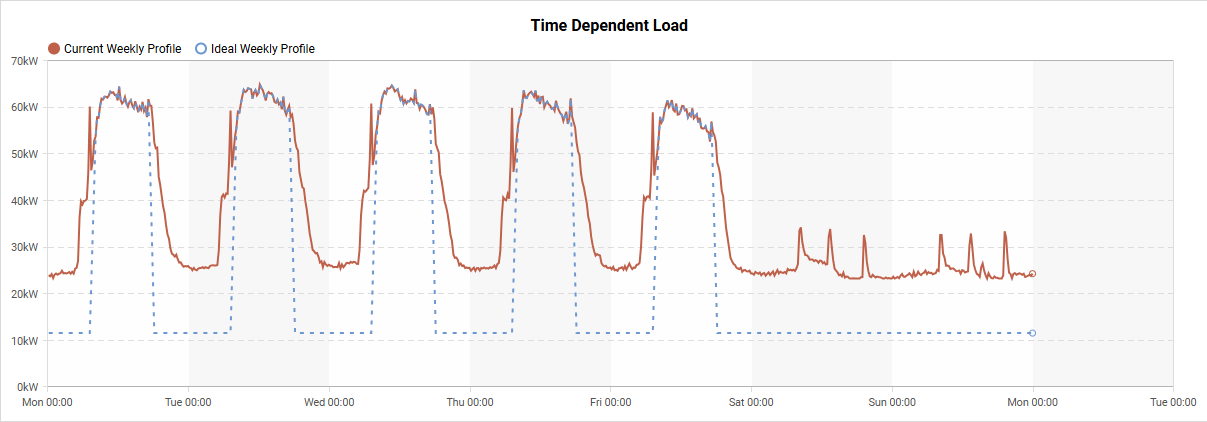
When working with TOWT (Time-Of-Week and Temperature) models, it’s just as important to account for time dependent load – patterns driven not by weather, but by routine. These time-of-week (TOW) driven variations reflect predictable behaviors: office occupancy, operational schedules, or equipment cycles. They repeat week after week, regardless of outdoor conditions.


When modeling the time dependent load – each hour of the week (or 15-minute, 5-minute interval) is treated as a distinct category, allowing the model to capture patterns in energy consumption independently of weather influences. These are typically related to occupancy, schedules, or equipment cycles.


For those who want to dig a bit deeper into the technical side…


To represent these categorical time periods numerically, one-hot encoding (OHC) is used. Using this technique, we transform each time interval into a binary vector where only the element corresponding to the current time slot is set to 1 and all the others are 0. These vectors serve as independent variables in the resulting regression model, enabling it to learn separate baseline consumption levels for each time period. This article provides a clear illustration of how one-hot encoding works, along with simple examples.  https://www.geeksforgeeks.org/ml-one-hot-encoding/


Granularity – How precise should your time model be?


The TOWT model reflects multiple levels of temporal granularity, depending on the available data and the desired resolution of analysis. Time-of-week OHC can be constructed at different intervals—such as hourly, 15-minute, or even 5-minute.

Comparison of time dependent loads of hourly, 15-minute and 5-minute models. Y-axis shows time dependent load [kW]. The x-axis shows the hour of the day.

Choosing the appropriate resolution is a tradeoff between capturing time-sensitive variability and maintaining model stability. As you can see in graph above, moving from hourly to 15-minute granularity makes a significant difference, revealing much finer operational patterns – such as short-duration spikes or control system behavior. 


Variants of TOW Modeling


Each building may require a different definition of the TOW structure, depending on how complex its operational schedule is and how much historical data is available. For facilities with consistent, predictable usage, a simple approach – such as a single daily profile repeated across the week – might be sufficient. But this isn’t suitable for most commercial buildings, which tend to follow more varied routines. A more common  approach is the typical TOWT, which assigns a separate profile to each day of the week, allowing the model to reflect different usage on weekdays versus weekends. For even higher fidelity, the model can incorporate custom day types – such as holidays, maintenance periods, or seasonal shutdowns – by adding binary indicators or grouping time slots differently. 

Time dependent load of 15-minute model where each day of week is represented separately.
Conclusion

The Time-of-Week and Temperature (TOWT) model has become a widely recognized and trusted approach for detailed energy consumption modeling. One of its greatest strengths lies not just in its predictive accuracy, but in its transparency.


Unlike many black-box machine learning models—such as neural networks—that may yield high performance but little interpretability, TOWT offers clear, explainable parameters. These include distinct components for weather-dependent loads and time-of-week-dependent loads, which provide valuable insights into the underlying behavior of a building. In essence, you’re not just getting a forecast—you’re gaining a deeper understanding of how and why a building consumes energy the way it does.


This interpretability is critical in real-world energy analytics, where decision-makers need to justify savings, uncover inefficiencies, and tailor operational strategies based on specific drivers. For example, knowing how much of a building’s load is due to weather (e.g., cooling demand) versus operational schedules (e.g., peak working hours) enables targeted energy-saving measures.


Thanks to its balance between statistical rigor and practical insight, TOWT remains a cornerstone method for analysts, auditors, and engineers working on high-resolution, actionable energy models.

Categories
Uncategorized

Efficient Multisite Energy Analysis Through AI and Tailored KPIs

AI for Main Electricity Meter Analysis: The Basics

Artificial Intelligence (AI) is revolutionizing energy analysis by turning granular smart meter data into actionable insights. It enables us to detect inefficiencies, forecast usage, and optimize building performance at scale.

This article focuses on analyzing main electricity meters in building portfolios—though the same principles apply to heat, submeters, and other systems. We also highlight the value of explainable AI models that provide both transparency and building-specific insights. Unlike black-box approaches, these tools help users understand and trust the logic behind optimizations.


At the heart of AI-based energy analysis is model identification using historical data. By analyzing a base period, the model learns the typical energy behavior of a building, which can then be used for a variety of applications:

  • Anomaly Detection: Automatically flagging deviations from expected patterns, whether caused by equipment failures or incorrect schedules.
  • Energy Conservation Measures (ECMs) Evaluation: Assessing the impact of implemented measures, such as lighting upgrades or HVAC adjustments.
  • Predictions: Providing accurate energy forecasts for budgeting and operational planning.
  • Demand Response Scenarios: Simulating and optimizing load reductions during peak demand periods.
  • Benchmarking: Comparing performance across buildings or time periods to identify underperforming sites.

Various machine learning models can support these tasks, including neural networks, gradient boosting methods like XGBoost, support vector regression, and Time-of-Week and Temperature (TOWT) models. One example builds on TOWT and combines advanced optimization with explainability to deliver deeper, more actionable insights into consumption patterns. This sets the stage for powerful multisite portfolio analysis, with AI scaling insights across hundreds of buildings.

Analyzing Building Portfolios Using Only Main Meter Data

Once AI proves its value at a single site, it’s natural to scale up—because the true power of AI shines when applied across entire building portfolios. By separating weather-dependent and time-dependent loads, AI helps us better understand what drives energy use. And with hundreds of sites, tailored Key Performance Indicators (KPIs) become essential for making sense of the data.

Cooling Setback Insights
Image: Weather-dependent load graph with outdoor air temperature [°F] on the X-axis and additional energy consumption due to weather [kW] on the Y-axis. The blue line represents the unoccupied state, and the red line represents the occupied state. The overlap between the two lines indicates a missing setback between these operational modes.

In well-managed office buildings, cooling loads should drop significantly when spaces are unoccupied—especially over weekends. Yet, patterns uncovered through AI often reveal something else. Even buildings that appear efficient on paper may show signs of systems running outside expected schedules.


What’s striking is that these insights come from something as simple as main electricity meter data—no extra sensors or submeters needed. It’s a reminder of how much valuable information is already available, waiting to be uncovered through the right lens.


Some common issues include:

  • Not Integrated Cooling
    Cooling systems run independently of actual occupancy, responding only to outdoor temperature. The result: cooling continues over the weekend, even when no one is there.
  • Overcorrections
    Setbacks may be in place but have been manually disabled—often due to Monday morning comfort complaints. For example, cooling a branch on Saturday has little impact on comfort by Monday, but disabling the entire weekend setback wastes energy.
  • Partial Occupancy, Full Cooling
    Only part of the building is in use, but the entire system is cooling as if it were fully occupied.

AI changes the game. With only main meter data, we can uncover hidden inefficiencies, quantify them, and prioritize what matters most.


Consider this: How would you typically find out that a bank branch is cooling over the weekend? No one’s there to notice. There are no complaints. Traditional methods—manual schedule reviews or deploying sensors—are time-consuming, costly, and don’t scale. AI, on the other hand, does scale. It can analyze hundreds of sites automatically and highlight problems in seconds—delivering actionable insights straight to technicians.

Quantifying Performance with KPIs

Spotting inefficiencies is only the beginning. Recognizing problems remotely is helpful—but KPIs make it possible to take action. By translating model outputs into structured, quantifiable metrics, we can benchmark across an entire portfolio and pinpoint the outliers—the “black sheep.”


KPIs help focus attention. Instead of reviewing every building, they steer teams to the ones with the greatest potential for improvement. When a problematic site is flagged, on-site visits can be targeted and efficient—guided by patterns already found in the data.

Real-World KPI Case Study

This approach was applied to a portfolio of 15 buildings, each monitored using 15-minute main meter data.

Step 1: Identifying the Black Sheep

Using historical data, models were trained and evaluated for each site. When KPI comparisons were made, one site clearly stood out. It showed consistently high energy use during nights and weekends—times when the building was expected to be unoccupied. High setback ratios and unusually high base loads raised suspicions of unnecessary cooling during off-hours.

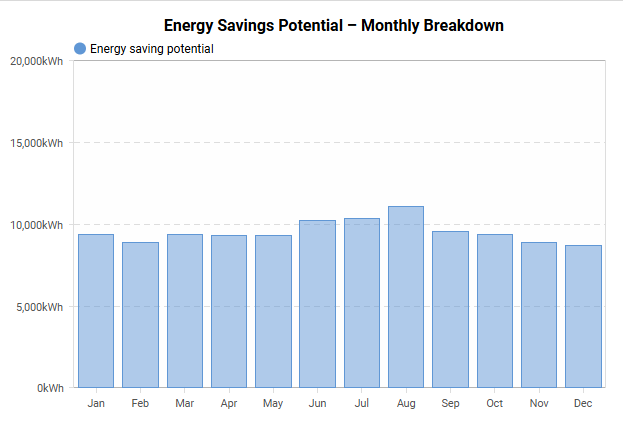
An overview of portfolio KPIs showing energy savings potential.
Step 2: On-Site Inspection with Clear Direction

Guided by the data, technicians knew exactly what to look for. At the flagged site, they found that chillers were operating independently of the building management system, running even when no one was there. The site was quickly prioritized for recommissioning.


The result? After reintegrating the chillers into the control system, the building saved 195 MWh annually. The cost savings paid back the investment in less than 12 months.

Conclusion

AI-powered analysis of main meter data offers a scalable, cost-effective way to detect hidden inefficiencies across large portfolios. By combining explainable models with tailored KPIs, we move from raw data to real-world impact—quickly identifying black sheep, prioritizing actions, and delivering measurable results. No extra hardware. No guesswork. Just better decisions, made faster.

Categories
Uncategorized

The Data Doesn’t Lie — But Someone Tried To

It’s always good practice to double-check your input data before diving into analysis. Sometimes you’ll catch small inconsistencies — and sometimes, you’ll uncover something more curious.


In the anonymized chart below, something didn’t quite add up — literally. At first glance, we see a standard consumption profile. But then, suddenly, the hot water flow drops into negative values. Suspicious already — but when you look closer, the negative hot water flow has the exact same amplitude as the cold water consumption. Coincidence? Unlikely.

Hot and cold water consumption.

As it turns out, this wasn’t a bug, but a shady workaround: by blending some hot into the cold line, someone was quietly lowering their hot water bill. After all, hot water tends to cost more — and if the cold water meter doesn’t mind going a bit into the negatives, why not? 


Apparently, the data didn’t. The takeaway? Always check your inputs — not just for errors, but for creative interpretations of how things should work. Sometimes, the data doesn’t just show inefficiencies — it reveals cheeky tricks hiding in plain sight.


And in this case? The little discovery led to a practical outcome: plans to install check valves (non-return) so that future “reverse savings” won’t be an option.