
Large Language Models in Energy and Buildings – Recent Perspectives
Perspectives Large language models (LLMs) have rapidly become one of the hottest topics across industries, and the building and energy domains are no exception. Over
In this case study, Energy Twin’s BEI machine learning solution was integrated into Twinit’s digital twin platform to uncover new opportunities for optimization at the IKON Innovation Centre. The advanced analysis identified areas for further energy efficiency improvements in an already well-managed building. This collaboration demonstrates the potential of combining digital twin technology with machine learning to enhance building operations.
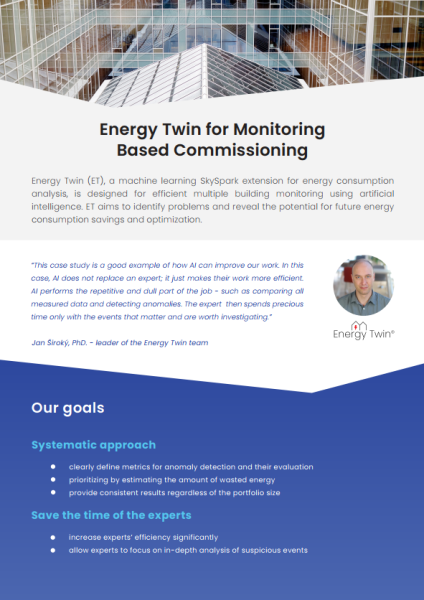
This case study is a good example of how AI can improve our work. In this case, AI does not replace an expert; it just makes their work more efficient. AI performs the repetitive and dull part of the job – such as comparing all measured data and detecting anomalies. The expert then spends precious time only with the events that matter and are worth investigating.
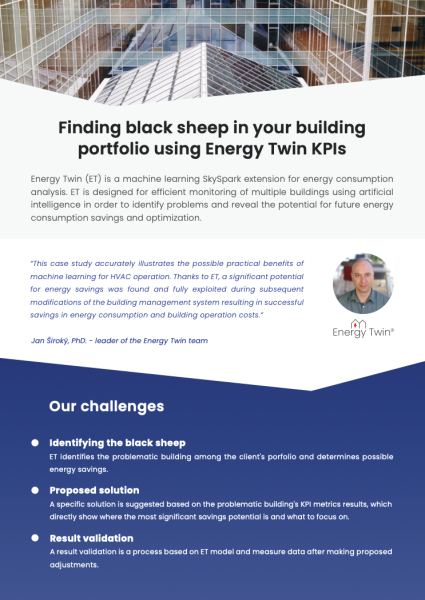
This case study accurately illustrates the possible practical benefits of machine learning for HVAC operation. Thanks to ET, a significant potential for energy savings was found and fully exploited during subsequent modifications of the building management system resulting in successful savings in energy consumption and building operation costs.
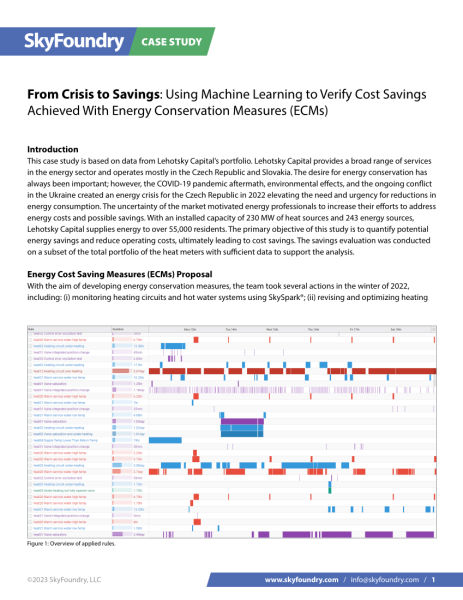
This case study demonstrates the potential of energy-saving measures to achieve significant cost savings and reduction of energy consumption, even in challenging market environments. Immediate impact evaluation tools, such as Energy Twin Interactive and SkySpark, can enhance the efficiency of implementing such measures. These tools provide prompt feedback for fine-tuning and adjusting measures, while automating mundane tasks, thus reducing the workload of energy experts.
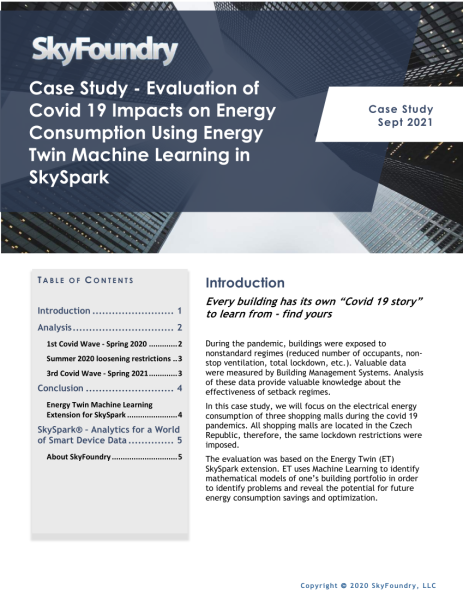
During the pandemic, buildings were exposed to nonstandard regimes (reduced number of occupants, nonstop ventilation, total lockdown, etc.). Valuable data
were measured by Building Management Systems.
Analysis of these data provide valuable knowledge about the effectiveness of setback regimes.

Perspectives Large language models (LLMs) have rapidly become one of the hottest topics across industries, and the building and energy domains are no exception. Over

In the realm of energy data evaluation, machine learning models have unlocked significant potential. These tools support everything from energy conservation analysis to anomaly detection

Some years ago, there was an energy-saving modernization project on a building in the Czech Republic. Manual HVAC controls were replaced by a modern automation

As electric vehicles (EVs) become more common, managing their charging demand presents new challenges – especially in buildings with limited grid connections. In this week’s

Energy Twin and the University Centre for Energy Efficient Buildings (UCEEB) of Czech Technical University in Prague explored the rising importance of load-side flexibility in today’s dynamic energy systems.

Energy savings are a cornerstone of any robust ESG strategy, driving both environmental responsibility and financial performance. At Energy Twin, we leverage advanced AI to